Introduction: The Choice That Every Emerald Buyer Faces
Emeralds have captivated humanity for thousands of years — their deep, verdant green a symbol of rebirth, renewal, and timeless elegance. From Cleopatra’s legendary adornments to modern-day bagues de fiançailles en émeraude, this gemstone commands attention and admiration. But as lab grown alternatives become increasingly sophisticated and accessible, buyers face a pivotal question: Natural Emerald and Diamond Ring vs lab grown emerald — which one is right for you?
This guide cuts through the marketing noise to give you a clear, honest comparison. Whether you’re choosing a Natural Emerald Ring 925 Sterling Silver piece for your engagement ring or simply want to understand the market, we’ve got the answers you need.

What Is a Lab Grown Emerald?
A Lab Emerald and Diamond Engagement Ring is a gemstone produced in a controlled laboratory environment that mimics the natural conditions under which emeralds form deep within the Earth’s crust. The most common method is called hydrothermal synthesis — a process where nutrient-rich aqueous solutions are heated under high pressure to encourage beryl crystals to grow.
Just like their natural counterparts, lab grown emeralds are made of beryllium aluminium silicate (Be3Al2Si6O18) colored by traces of chromium and sometimes vanadium. The result is a gemstone that is chemically, physically, and optically identical to a mined emerald.
It’s important to note that “lab grown” is not the same as “imitation.” Materials like green glass or cubic zirconia merely look like emeralds. A real emerald vs synthetic emerald comparison shows two genuinely different categories: one is a natural geological product, the other is a scientifically engineered one — but both are real emeralds in every measurable sense.

Chemical and Physical Properties: Are They Really Identical?
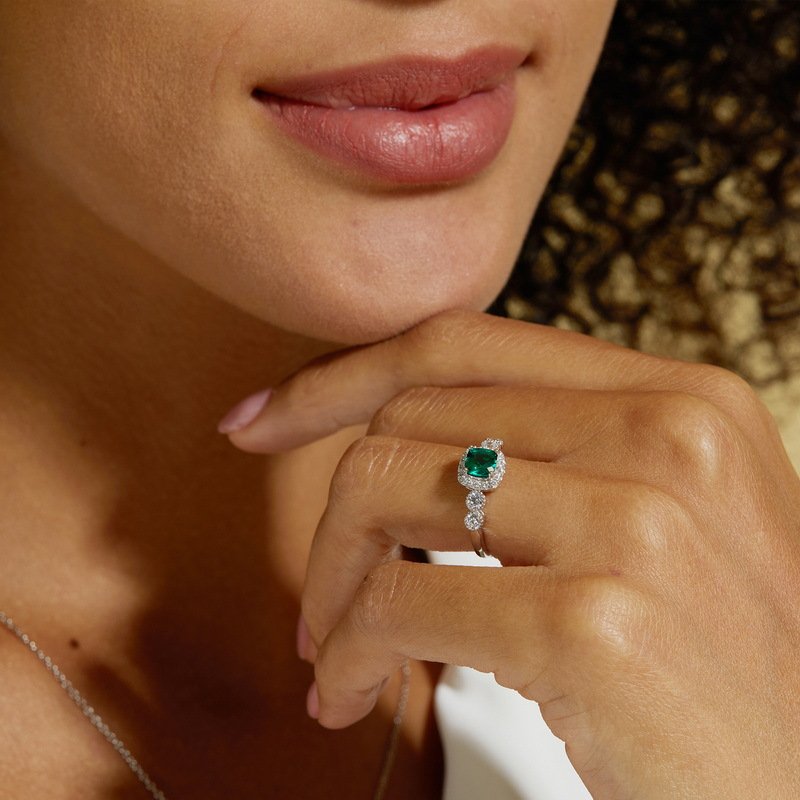
Here’s where the science gets fascinating. On the molecular level, natural and lab grown emeralds are virtually indistinguishable:
| Property | Natural Emerald | Lab Grown Emerald |
|---|---|---|
| Chemical Formula | Be3Al2Si6O18 | Be3Al2Si6O18 |
| Hardness (Mohs) | 7.5 – 8 | 7.5 – 8 |
| Refractive Index | 1.577 – 1.583 | 1.577 – 1.583 |
| Specific Gravity | 2.72 | 2.72 |
| Birefringence | 0.006 | 0.006 |
| Color-Causing Element | Chromium / Vanadium | Chromium / Vanadium |
Both score 7.5–8 on the Mohs hardness scale, making them durable enough for everyday wear in rings and other jewelry. Both have the same refractive index and optical properties. To a gemologist using standard equipment, the only reliable way to tell them apart is through advanced spectroscopic analysis that detects microscopic growth patterns and trace element signatures.
For the everyday buyer, this means one thing: in terms of beauty and durability, the difference is negligible.
Visual Differences: The “Fingerprint” of Nature
While the chemistry matches, the visual experience can differ — and this is where many buyers find their decision becomes personal.
The Beauty of Inclusions
Natural emeralds almost always contain inclusions — tiny internal fractures, mineral crystals, and growth patterns formed over millions of years underground. Gemologists call these internal characteristics jardin (French for “garden”), and they’re considered the hallmark of authenticity. The finest Colombian emeralds, for instance, often display a velvety, “sleepy” green glow caused by fine inclusions that diffuse light beautifully.
Lab grown emeralds, produced over weeks rather than millennia, tend to have fewer visible inclusions. Their internal structure is more uniform, resulting in a cleaner, more “perfect” appearance under magnification. To some, this makes them more visually appealing. To purists, it removes the geological story that makes natural emeralds so romantic.
Color Tone and Saturation
Color is perhaps the most subjective differentiator. Natural emeralds display a remarkable range of green tones — from yellowish-green to pure green to bluish-green — depending on their origin. Colombian emeralds are prized for their pure, warm green; Zambian emeralds are known for their bluish-green hue and often exceptional clarity.
Lab grown emeralds can be engineered to produce consistent, saturated greens. Some buyers find them even more vividly colored than the average natural stone. However, the very consistency that makes them appealing can also feel less organic to a discerning eye.
Price Comparison: What Does Each Option Actually Cost?
This is where the natural emerald vs lab grown emerald decision becomes most practical for most buyers. Price differences are substantial, and understanding them is key to making a smart purchase.
Natural Emeralds: A Premium Investment
High-quality natural emeralds are genuinely rare. The combination of the right chemical environment, millions of years of formation, and the luck of extraction means that fine emeralds are far less common than diamonds of equivalent carat weight. A 1-carat Colombian emerald with excellent color and moderate inclusions can easily cost $3,000 to $10,000 or more — before considering the setting.
Key pricing factors include:
- Origin: Colombian emeralds command the highest prices, followed by Zambian and Brazilian stones
- Couleur : Pure green with strong saturation and even distribution is most valuable
- Clarté : “No oil” or minimally treated emeralds cost dramatically more than heavily included stones
- Treatment: The vast majority of natural emeralds are oiled to fill fractures. Untreated stones command a massive premium
- Carat weight: Prices increase exponentially with size due to rarity
Lab Grown Emeralds: Dramatically More Accessible
Lab created emeralds are typically 60–80% less expensive than their natural counterparts of comparable appearance. A 1-carat lab grown emerald of excellent color might cost $200 to $800 — making it possible to purchase significantly larger, more vibrant stones for the same budget.
This price advantage means you can opt for a more elaborate setting, a larger center stone, or simply stay within a tighter budget without sacrificing visual impact. For many modern couples, this value proposition is compelling.
The Investment Angle
If you’re considering an emerald purchase as an investment, natural stones have a proven track record of retaining and appreciating value — particularly fine, untreated specimens from renowned origins like Colombia. Lab grown emeralds, like all lab grown gemstones, have a much shorter track record and no meaningful secondary market. Their value is primarily aesthetic and emotional rather than financial.
Which Should You Choose? A Practical Decision Framework
The right choice depends entirely on your values, budget, and what the emerald represents to you. Here’s a framework to help you decide:
Choose a Natural Emerald If:
- You value rarity and geological authenticity
- The gemstone represents a significant milestone (engagement, anniversary)
- You have budget flexibility for a smaller but genuine stone
- Long-term value retention or appreciation matters to you
- You appreciate the unique inclusions and “personality” of natural stones
Choose a Lab Grown Emerald If:
- You want the maximum visual impact within your budget
- Ethical sourcing is a top priority (lab gems have no mining impact)
- You prefer a cleaner, more internally flawless appearance
- You want a larger stone or more elaborate setting
- You view the ring as primarily a symbol of love rather than an investment
For bagues de fiançailles, many couples find that a lab grown emerald allows them to choose a stone that truly takes their breath away — a larger, more vibrant center stone in a beautiful setting — without the financial stress of a five-figure natural gem.
Certificate and Authenticity: How to Know What You’re Buying
Whether you choose natural or lab grown, always insist on a certificate from a reputable gemological laboratory. Here’s what to look for:
For Natural Emeralds
- IGL (International Gemological Laboratory)
- GRS (GemResearch Swisslab)
- AGL (American Gemological Laboratories)
- GIA (Gemological Institute of America)
A certificate from one of these labs will confirm the stone’s natural origin, color grade, clarity grade, any treatments applied, and in many cases, the geographic origin. For significant purchases, an origin report can add substantial value.
For Lab Grown Emeralds
Reputable sellers will clearly disclose that a gemstone is lab grown, and it should come with a certificate stating this explicitly. Be wary of any seller who does not clearly label lab grown stones — this is both a legal requirement and a mark of ethical business practice.

Making the Right Choice for You
The debate between real emerald vs synthetic emerald isn’t about which is “better” — it’s about which is right for your specific situation. Both are genuine, beautiful, and valid choices. Both produce stunning jewelry that will be treasured for generations.
Au EmeraldsRing, we offer both natural and lab created emerald jewelry, so you can explore both options and find the perfect piece that aligns with your values and your budget.
Ready to Find Your Perfect Emerald?
Whether you’re drawn to the timeless allure of a émeraude naturelle or the exceptional value of a lab created emerald, our curated collection has something for every preference and budget. Our team is here to help you make an informed, confident choice.
Browse our full collection of emerald rings →
Have questions about choosing between natural and lab grown? Contact us today — our gem experts are ready to guide you through every step of your purchase.
 English
 French
 German
 Italian
 Spanish
 Arabic
 Japanese
 Portuguese
 Korean
 Dutch
Dutch