
Emeralds are one of the few gemstones that almost always require special treatment to reach their full beauty — and that treatment needs maintenance. If you’ve noticed your emerald looking dull, cloudy, or less vibrant than when you first got it, the culprit is likely the same thing that made it beautiful in the first place: oil.
Understanding emerald re-oiling is essential knowledge for any emerald ring owner. This guide explains exactly why emeralds need oil, how to recognize when yours needs re-oiling, how the professional process works, costs involved, and what to do afterward to keep your stone beautiful.
Why Emeralds Need Oil: The Nature of the Stone
To understand emerald re-oiling, you first need to understand why oil is used on emeralds in the first place. The answer lies in the unique geology of this gemstone.
The Fracture Problem
Emeralds form under intense heat and pressure deep within the earth. This process creates characteristic internal fractures — called inclusions or “jardin” (French for garden) — that are part of every natural emerald’s fingerprint. These inclusions aren’t flaws; they’re proof of authenticity and part of what makes each emerald unique.
However, these fractures also make light scatter in ways that can reduce clarity and diminish the stone’s brilliance. Without treatment, most emeralds would appear heavily included and less valuable.
What Oil Does
Oil — typically cedarwood oil or similar colorless, highly refractive natural oils — is applied to emeralds to fill surface-reaching fractures. The oil has a similar refractive index to the emerald itself, so light passes through the fractured areas more smoothly. This:
- Improves clarity and transparency
- Enhances color vibrancy
- Reduces the visibility of inclusions
- Creates a smoother visual surface
It’s important to note that oil treatment is a widely accepted industry practice. Nearly all emeralds on the market — from commercial to fine jewelry quality — are oiled. An entirely unoiled emerald of significant size and quality is extraordinarily rare and expensive.
Types of Oil Treatments
Emerald oil treatments range from minimal to significant:
- Minor oiling: Only tiny surface fractures are treated. This is the most stable and desirable treatment level.
- Moderate oiling: More significant fractures are filled. Still stable but requires more careful maintenance.
- Significant oiling: Extensive fracture filling. These emeralds require the most careful maintenance and may need re-oiling more frequently.
- Resin or polymer treatments: Some commercial emeralds use synthetic fillers instead of natural oil. These are more stable but also more controversial.

Signs Your Emerald Needs Re-Oiling
How do you know when it’s time for emerald oil treatment maintenance? Watch for these signs:
Visual Indicators
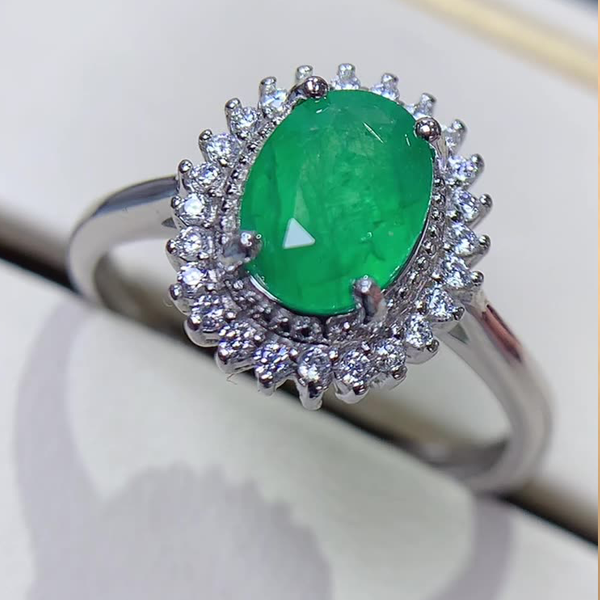
- The stone appears cloudy or hazy: Instead of clear, deep green, the emerald looks milky or has areas of reduced transparency.
- Fractures are more visible: You can see lines or patterns in the stone that weren’t apparent before, especially in good light.
- Color appears faded: The rich green has become muted or washed out.
- Uneven color distribution: Some areas of the stone look darker while others look lighter.
Behavioral Indicators
- The ring has been heavily exposed to chemicals: Regular contact with cleaning products, perfumes, or pool water accelerates oil loss.
- It’s been over 12 months since the last re-oiling: Even with excellent care, oil treatments naturally degrade over time.
- Heat exposure: If the ring has been exposed to high heat (hot tubs, saunas, hot cars, or cooking), the oil may have evaporated or migrated.
A Note on New Rings
If you recently purchased an emerald ring and it arrived beautifully clear and vibrant but is now looking duller after a few weeks of wear, it may simply need a brief period to acclimate — or it may have been over-oiled initially, and excess oil is wicking away. If the dullness persists beyond a few weeks of normal care, have it assessed for re-oiling.
How Often Should You Re-Oil?
The re-oiling frequency for your emerald ring depends on several factors:
- Quality of the original treatment: Higher-quality initial oiling tends to last longer
- Wear habits: Daily wear exposes the stone to more oils from skin, soaps, and environmental factors
- Chemical exposure: Frequent contact with perfumes, cleaning products, or chlorinated water accelerates oil loss
- Age of the ring: Older rings may need more frequent maintenance
General Guidelines
- Well-maintained rings: Every 12–24 months
- Rings with moderate daily wear: Every 12–18 months
- Rings with heavy exposure or lower-quality treatments: Every 6–12 months
The best approach is to have your ring professionally inspected annually, and have re-oiling done when the jeweler confirms it’s needed — not on a fixed schedule that may be too frequent or infrequent for your specific stone.
The Professional Re-Oiling Process
Professional emerald re-oiling is a specialized process that should only be done by an experienced colored gemstone specialist. Here’s what to expect:
Step 1: Assessment
A qualified jeweler or gemologist will examine the emerald under magnification (usually 10x–30x magnification, called a jeweler’s loupe or microscope) to assess the extent of oil loss and the condition of internal fractures.
Step 2: Surface Cleaning
Before re-oiling, the stone must be completely clean and dry. Any residue on the surface would trap contaminants under the new oil and cause problems. The stone is cleaned using gentle, appropriate solvents.
Step 3: Vacuum or Pressure Treatment
Professional re-oiling uses vacuum or pressure chambers to force oil into the fractures more deeply and evenly than simple surface application can achieve. The stone is submerged in oil inside a chamber, and air is removed under vacuum, allowing the oil to penetrate fractures completely. This step is what separates professional re-oiling from amateur attempts.
Step 4: Curing
After treatment, the oil is allowed to settle and cure. The stone is handled carefully during this period to avoid disturbing the oil placement.
Step 5: Final Inspection
The finished emerald is examined under magnification to verify that fractures are well-filled and the stone’s appearance has been restored.
Can You Re-Oil an Emerald Yourself?
The short answer is: you shouldn’t attempt it.
Why DIY Re-Oiling Fails
Home re-oiling attempts typically fail because:
- Without vacuum equipment, oil only penetrates surface fractures — not deeper inclusions where it matters most
- Amateur application can trap air bubbles, making the stone look worse
- Using the wrong type of oil (not gem-grade cedarwood oil) can discolor or damage the stone
- Surface application without proper cleaning first traps contaminants under the oil
- Oil applied to the surface without penetration can create an uneven, waxy appearance
Risks of DIY Re-Oiling
Beyond ineffectiveness, amateur attempts can introduce new problems:
- Using incompatible oils that react with the original treatment
- Creating a hazy or cloudy appearance that requires professional intervention to fix
- Accidentally exposing the stone to contaminants during the process
Always trust re-oiling to a professional colored gemstone specialist. The cost of professional re-oiling ($50–$200) is minimal compared to the potential cost of damaging a valuable emerald.
Cost of Re-Oiling
Re-oil emerald ring costs vary by location, jeweler expertise, and the complexity of the stone:
- Basic professional re-oiling: $50–$150
- Re-oiling with comprehensive cleaning and inspection: $100–$200
- Re-oiling plus repair (if setting also needs attention): $150–$400+
This cost is well worth it to restore a stone that might otherwise look lifeless. An emerald at peak clarity and color is genuinely a different gemstone.
After Re-Oiling: Care Tips
Once your emerald has been professionally re-oiled, following proper care will help the new treatment last as long as possible:
- Avoid heat: High temperatures can cause the fresh oil to migrate or evaporate. Skip the sauna and remove the ring before cooking with high heat.
- Be extra careful with chemicals for the first week: Give the new oil treatment time to fully cure and settle.
- Resume your normal gentle cleaning routine: Use only mild soap and warm water, as covered in our cleaning guide.
- Schedule your next inspection: Mark your calendar for 12 months out to have the ring checked again.
Re-Oiling: Part of Normal Emerald Maintenance
Think of re-oiling not as a sign that something is wrong with your emerald, but as a normal part of caring for a living gemstone. Just as you might condition leather or oil a wood surface, re-oiling is the maintenance step that keeps your emerald performing at its best.
With professional re-oiling every 12–24 months, combined with the daily care habits we’ve covered in this series, your emerald ring will remain as beautiful in 20 years as the day you first put it on.
Ready to invest in an emerald that will reward this kind of careful maintenance? Browse our collection of exquisite emerald rings, each ready to become a cherished heirloom.
 English
 French
 German
 Italian
 Spanish
 Arabic
 Japanese
 Portuguese
 Korean
 Dutch
Dutch